Berliner Debatte Initial
Sozial- und geisteswissenschaftliches Journal
The topics covered in the Berliner Debatte Initial range from research into transformation and Eastern Europe, which comprised its focus in the 1990s, to questions relating to the history of ideas, philosophy, social theory, and cultural sociology, to current socio-political debates and issues concerning the zeitgeist. The journal is aimed at a broad, interdisciplinary readership with the intention of critically reflecting on the socio-economic, political and cultural processes of change in Germany, Europe, and the world and initiating public debates about them.
Each issue is dedicated to a topic related to one of its focal areas and also contains a general section with additional articles as well as discussions and reviews.
> journal overview | > latest issues on our elibrary
Edited by

Editorial office
Thomas Müller (editor-in-chief)
Ulrich Busch
Wolf-Dietrich Junghanns
Thomas Möbius
Gregor Ritschel
Matthias Weinhold
Johanna Wischner
Advisory board
Robert Feustel
Wladislaw Hedeler
Heinrich Kirschbaum
Sandra Koch
Raj Kollmorgen
Christoph Michael
Robert Stock
Berliner Debatte Initial
General information
ISSN 0863-4564 (print)
ISSN 2941-3230 (online)
Founded: 1990
Publication frequency: quarterly
Size: 17 x 24 cm
Annual number of pages: ca. 576
Languages: German
Review section: Yes
Validation: peer review
First volumes published under the title Initial. Zeitschrift für Politik und Gesellschaft
- Dietrich’s Index Philosophicus
- Article first
- Ulrichs web
- Google Scholar
- World Affairs Online/IREON
Publishing information
Please send manuscript submissions to the editoral office (redaktion@berlinerdebatte.de). Submissions must be original articles (no translations) which must not be previously published. During the review process, manuscripts may not be submitted elsewhere. A manuscript submitted to the journal must be ready for publication, the editors do not accept partial or draft versions. In initial submissions, the citation rules of the journal do not have to be strictly followed.
All submissions are subjected to peer review. The review process can result in acceptance, the recommendation of revisions or rejection of the manuscript. The author is informed of the decision by email. The editors attempt to reach a decision within 3 months of the submission of the manuscript.
If a manuscript is accepted, the editors request a file with the final version. Please follow the guidelines of publisher and editors provided below.
There are no fees for submitting and publishing an article in the journal.
In our area for authors you will find all the general information you need about structuring your article, formatting your text, working with images and tables and so on. Here we have linked the most important pages for you:
- Technical requirements
- Contribution guidelines
- Text body
- Figures and images
- Tables
- Lists and bibliography
- Use of AI
Additional editorial information and citation guidelines
Contribution header
- General guidelines on the contribution header can be found under ‘Contribution guidelines’.
- The title in the original language is followed by the English translation of the title, unless the title is already in English.
- Contributions in Berliner Debatte Initial include abstracts and keywords in both the original language and, if applicable, in English.
Abbreviated references
- Titles of works quoted in the text are correctly placed within double quotation marks.
- References are included directly in the text in brackets. The source is given in brackets immediately after the statement to be cited. The abbreviated citation follows the author-year principle:
Here is a statement that needs to be substantiated (Hoyer 2023)
Here is a statement that needs to be substantiated (Hoyer 2023: 254) - Multiple quotations within a single work are separated by commas:
(Kullmann 1960: 58–63, 169–173, 221 f., 227, 366, 369) - Several short references of different works following one another are separated by semicolons:
(Dalfen 1972: 67; Dalfen 2012: 151–170; Radke-Uhlmann 2010: 29; Vancamp 2010) - If a person has published several works in the same year, these are distinguished from one another by lower-case letters at the end of the year:
(Meier 1999a: 5 f., 1999b: 17–23) - A reference to the same source cited immediately afterwards is abbreviated as ‘ibid.’ or ‘ibid.: page number’:
(Hempfer 2014: 22)
(Vgl. ebd.)
(Ebd.: 61) - Two consecutive pages are cited using ‘f.’, whilst more than two pages are cited using a ‘from–to’ range:
(Keitel 2018: 202 f.)
(Vasold 2008: 276–288)
Bibliography
- The bibliography with detailed references and sources is placed at the end of each contribtuion and is headed ”Bibliography“.
- The bibliography only contains all works cited in the text. The first level is sorted alphabetically by author, and the second by year of publication:
Fischer, Fritz (2004): Example title. Stuttgart: Steiner.
Fischer, Fritz (2012): Random title. Stuttgart: Steiner.
Schneider, Lisa (1982): Example title. Stuttgart: Steiner.
Schneider, Lisa (1986): Random title. Stuttgart: Steiner. - Main title and subtitle are always seperated by a full stop, not by a colon.
- If applicable, use the abbreviated form of the publisher‘s name:
Steiner; VS
Not: Franz Steiner Verlag; VS Verlag für Sozialwissenschaften
Monograph
- Last name, first name (year): Title. Subtitle. Place: Publisher.
Luhmann, Niklas (1984): Soziale Systeme. Grundriß einer allgemeinen Theorie. Frankfurt a. M.: Suhrkamp.
Contirbution in a journal
- Last name, first name (year): Title. Subtitle. In: Full journal title volume, issue, page numbers.
Band, Henri (2010): Die ”Natur“ als Einzugsgebiet der Soziologie. In: Berliner Debatte Initial 21, 3, pp. 171–179.
Contribution in an edited volume
- Last name, first name (year): Title. Subtitle. In: Last name, first name (ed.): Title. Subtitle. Place: Publisher, page numbers.
Jochum, Georg / Schaupp, Simon (2019): Die Steuerungswende. Zur Möglichkeit einer nachhaltigen und demokratischen Wirtschaftsplanung im digitalen Zeitalter. In: Butollo, Florian / Nuss, Sabine (eds.): Marx und die Roboter. Vernetzte Produktion, Künstliche Intelligenz und lebendige Arbeit. Berlin: Dietz, pp. 327–344.
Internet sources
- Last name, first name (year): Title. Subtitle. In: Full title of online journal volume, issue [or] date pof publication, page numbers. DOI [or] URL (Access DD.MM.YYYY).
Rancière, Jacques (2003): Glücksfall Politik. In: der freitag, 04.07.2003. URL: https://www.freitag.de/autoren/der-freitag/glucksfall-politik (Access 28.03.2024).
Please see our information on copyright, self-archiving rules and guidelines for the use of PDF reprints here:
For our publication ethics statement have a look here:
Discover the journal
Subscribe
For institutions: Do you wish to subscribe to Berliner Debatte Initial? Please get in contact with us and write to us here:
For private customers:
The journal and its editions
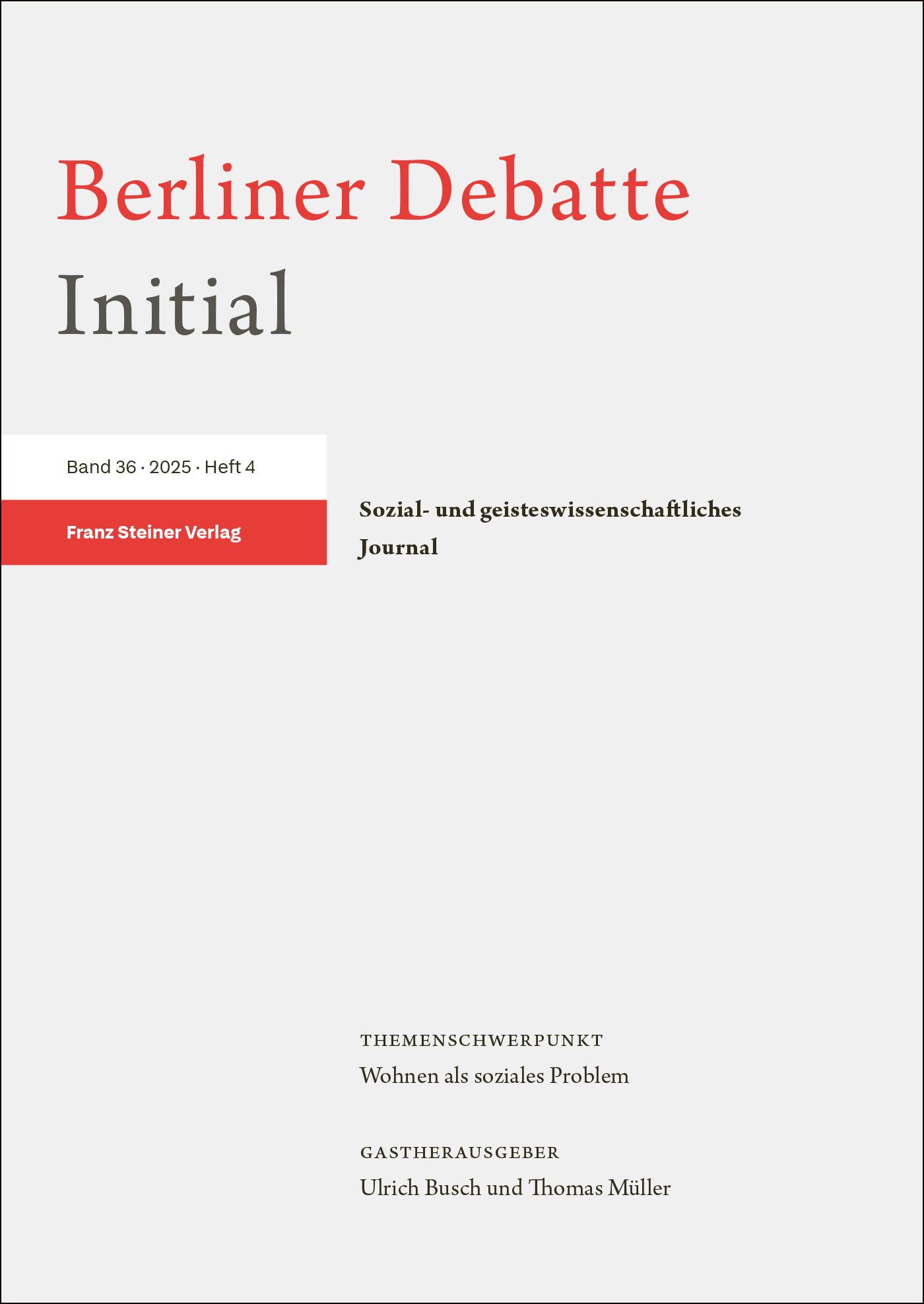
-
€18.00*
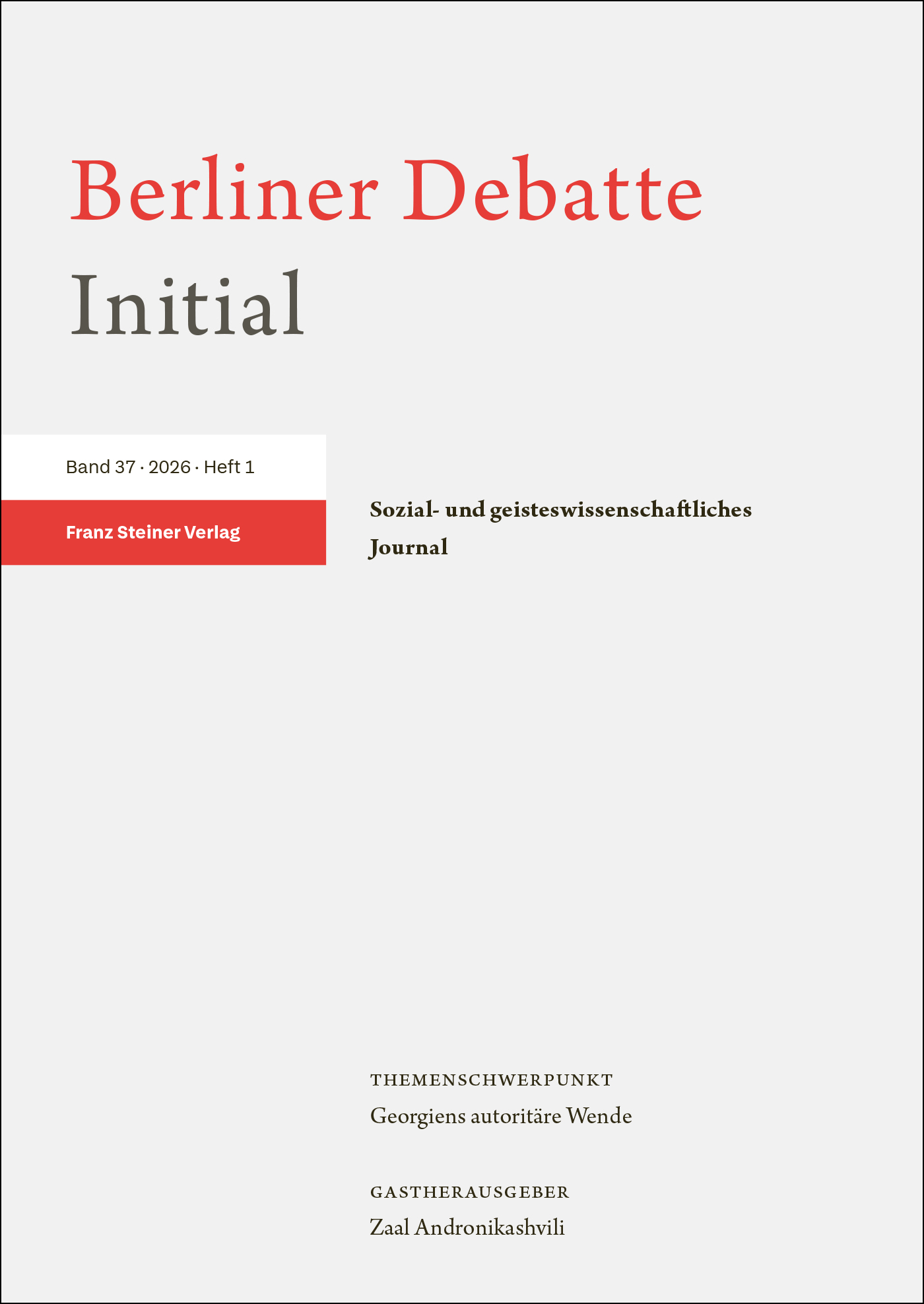
-
€18.00*
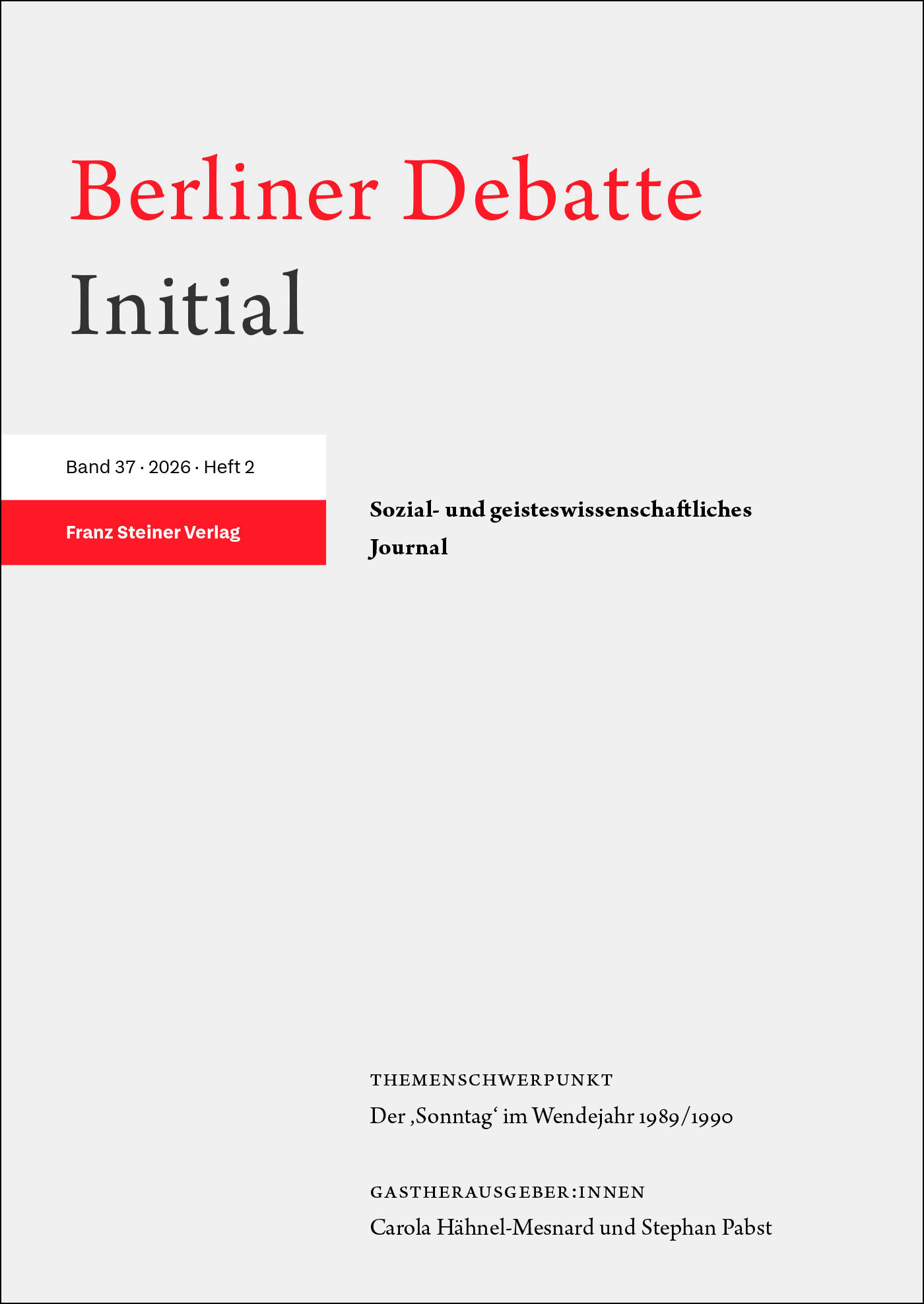
-
€18.00*
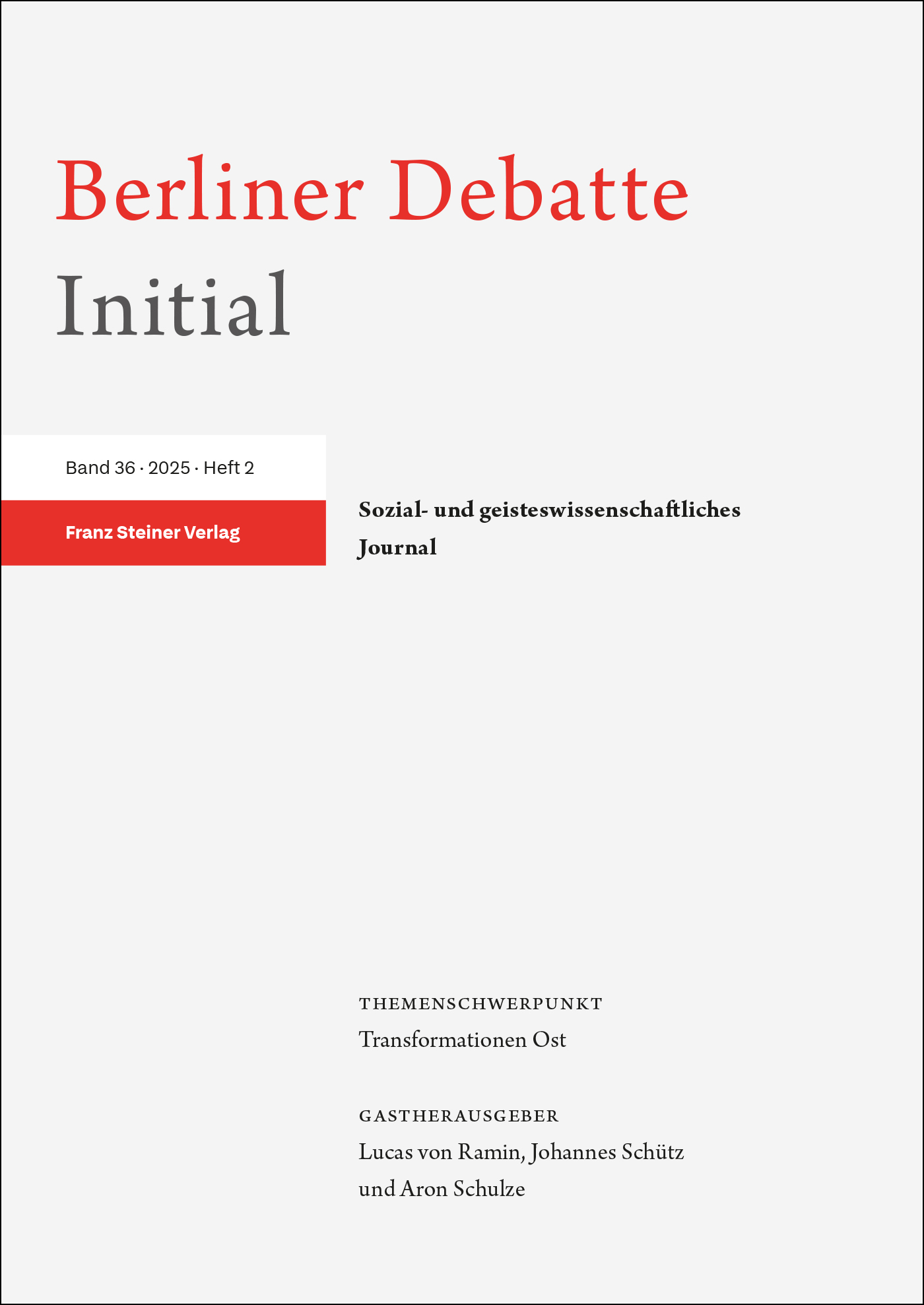
-
€18.00*
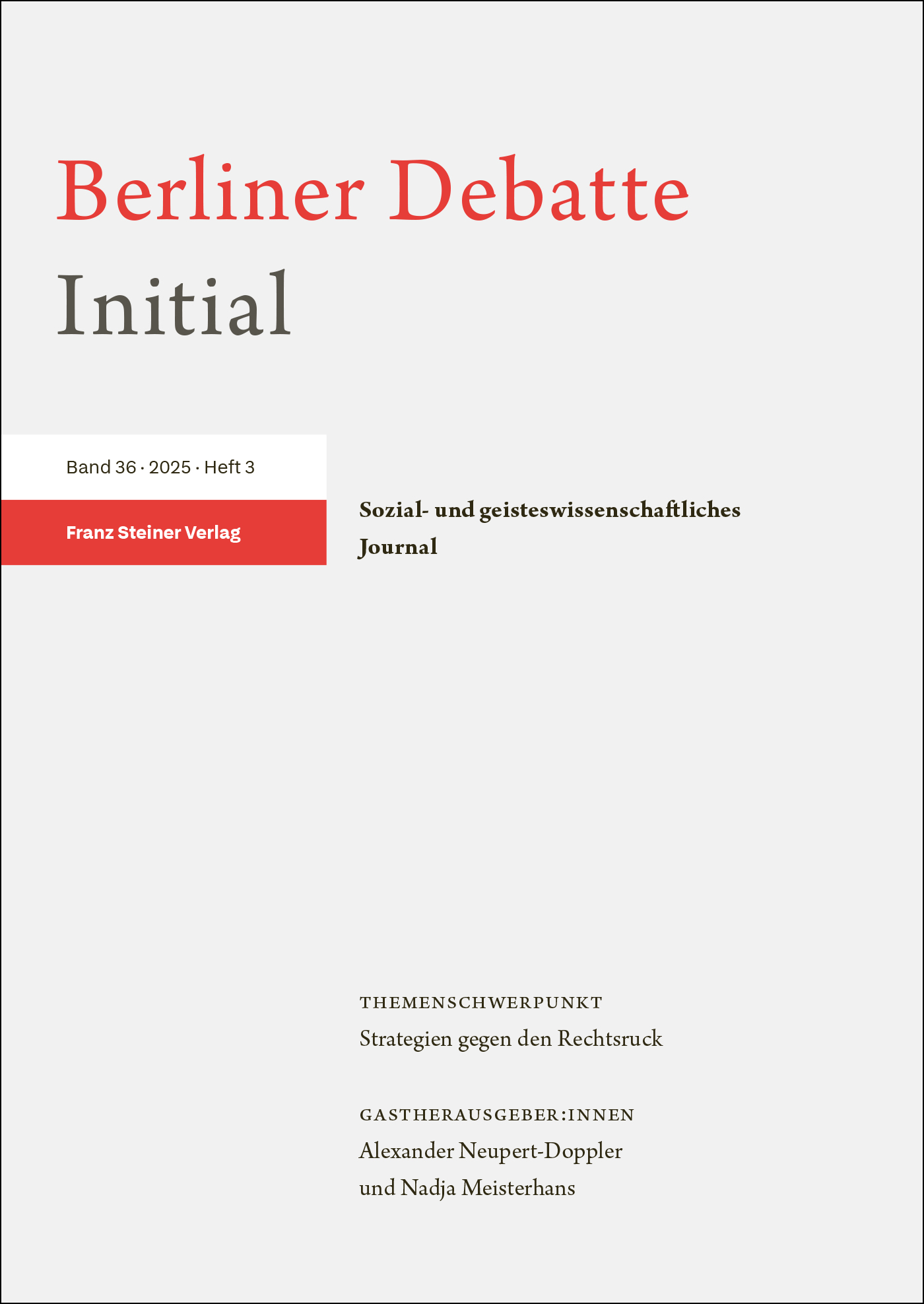
-
€18.00*